For individuals living with immunosuppression—whether following organ transplantation, managing autoimmune conditions with biologic therapies, or undergoing chemotherapy—the simple act of stepping outdoors carries a substantially different risk profile than for the general population. The skin, already compromised by reduced immune surveillance, becomes a primary target for ultraviolet radiation damage that the body struggles to repair. A dangerous assumption circulates in both patient communities and general health guidance: the belief that any high-SPF sunscreen from the high street will suffice for cancer prevention. This misconception fails to account for a critical regulatory and clinical distinction—the difference between cosmetic sunscreen products and CE-marked medical device photoprotection.
The clinical evidence reveals a stark reality: the peer-reviewed analysis published in Frontiers in Medicine confirms that up to 80% of solid organ transplant recipients develop actinic keratosis lesions—precancerous growths that represent the first step in a disease continuum leading to invasive squamous cell carcinoma. Yet many patients remain unaware that the regulatory framework governing medical sunscreens demands a fundamentally different level of clinical proof than the cosmetic alternatives lining pharmacy shelves. What does CE medical device classification actually mean for photoprotection effectiveness, and why does this regulatory status matter when your immune system cannot mount its usual defence against UV-induced DNA damage?
⚕ Information importante
This content is provided for informational purposes and does not constitute medical advice. Consult a qualified healthcare professional for any decisions concerning your health.
Before diving into the regulatory distinctions and clinical evidence, here are the essential protective principles every immunosuppressed patient should know immediately.
Critical protection points for immunosuppressed patients:
- Transplant recipients face dramatically elevated risk—up to 80% develop actinic keratosis lesions within years of immunosuppression
- CE-marked medical sunscreen requires clinical trial evidence in target populations, unlike cosmetic products
- SPF 50+ broad-spectrum UVA/UVB protection is the minimum standard for high-risk patients
- Reapplication every two hours during sun exposure is non-negotiable for maintained defence
- Annual dermatology surveillance complements photoprotection—early detection prevents progression to invasive cancer
Why immunosuppressed patients face extreme skin cancer risk
The immune system performs continuous surveillance, identifying and eliminating cells with damaged DNA before they can proliferate into cancerous growths. When immunosuppressive medications deliberately suppress this protective mechanism—as required to prevent organ rejection following transplantation, or to control autoimmune disease activity—the skin loses its primary defence against ultraviolet radiation damage. T-cell function, critical for recognising and destroying precancerous keratinocytes, becomes significantly impaired. The consequence is not merely a modest uptick in skin cancer incidence, but a transformation of risk magnitude that places immunosuppressed patients in an entirely different medical category.
Clinical research quantifies this elevated danger with sobering precision. Research indicates that solid organ transplant recipients experience risk increases of 65-fold or substantially higher for developing squamous cell carcinoma compared to age-matched individuals with intact immune function. This is not a marginal difference requiring statistical expertise to detect—it represents a fundamental shift in disease probability that demands equally fundamental changes in preventive strategy. The question for patients and clinicians alike becomes not whether aggressive photoprotection is justified, but rather what constitutes genuinely effective protection for this high-risk population.
80%
Proportion of solid organ transplant recipients who develop actinic keratosis lesions
Actinic keratosis lesions—rough, scaly patches that appear on sun-exposed skin—serve as visible markers of accumulated UV damage and impaired cellular repair. In the general population, many such lesions remain stable or even regress spontaneously as the immune system mounts a response. For immunosuppressed patients, however, the trajectory differs markedly. These lesions represent the initial stage in a disease continuum that can progress to invasive squamous cell carcinoma, with immunosuppression accelerating this progression and reducing the likelihood of spontaneous resolution. The Frontiers in Medicine analysis reveals that approximately 30% of transplant recipients develop five or more actinic keratosis lesions—a burden that significantly elevates subsequent skin cancer risk and necessitates ongoing dermatological management.
As documented in this NIH clinical review of immunosuppressed skin cancer, the dermatological consequences manifest not only as higher cancer incidence but also as more aggressive tumour behaviour and poorer treatment outcomes compared to skin cancers in immunocompetent individuals.
What sets CE-marked medical sunscreen apart
As set out in the MHRA‘s 2025 implementation framework for CE-marked devices, medical devices placed on the GB market must comply with post-market surveillance requirements that came into force on 16 June 2025. The European medical device framework establishes clear demarcation between cosmetic and therapeutic claims. Cosmetic products must meet basic safety standards and avoid making therapeutic disease claims. Medical devices, conversely, bear the CE marking specifically because they make therapeutic claims—such as preventing disease progression—and have undergone regulatory scrutiny to substantiate those claims with clinical evidence. When a sunscreen carries CE medical device classification for preventing actinic keratosis or reducing skin cancer incidence in immunosuppressed populations, it signals that the manufacturer has submitted clinical trial data demonstrating efficacy in that specific high-risk group.
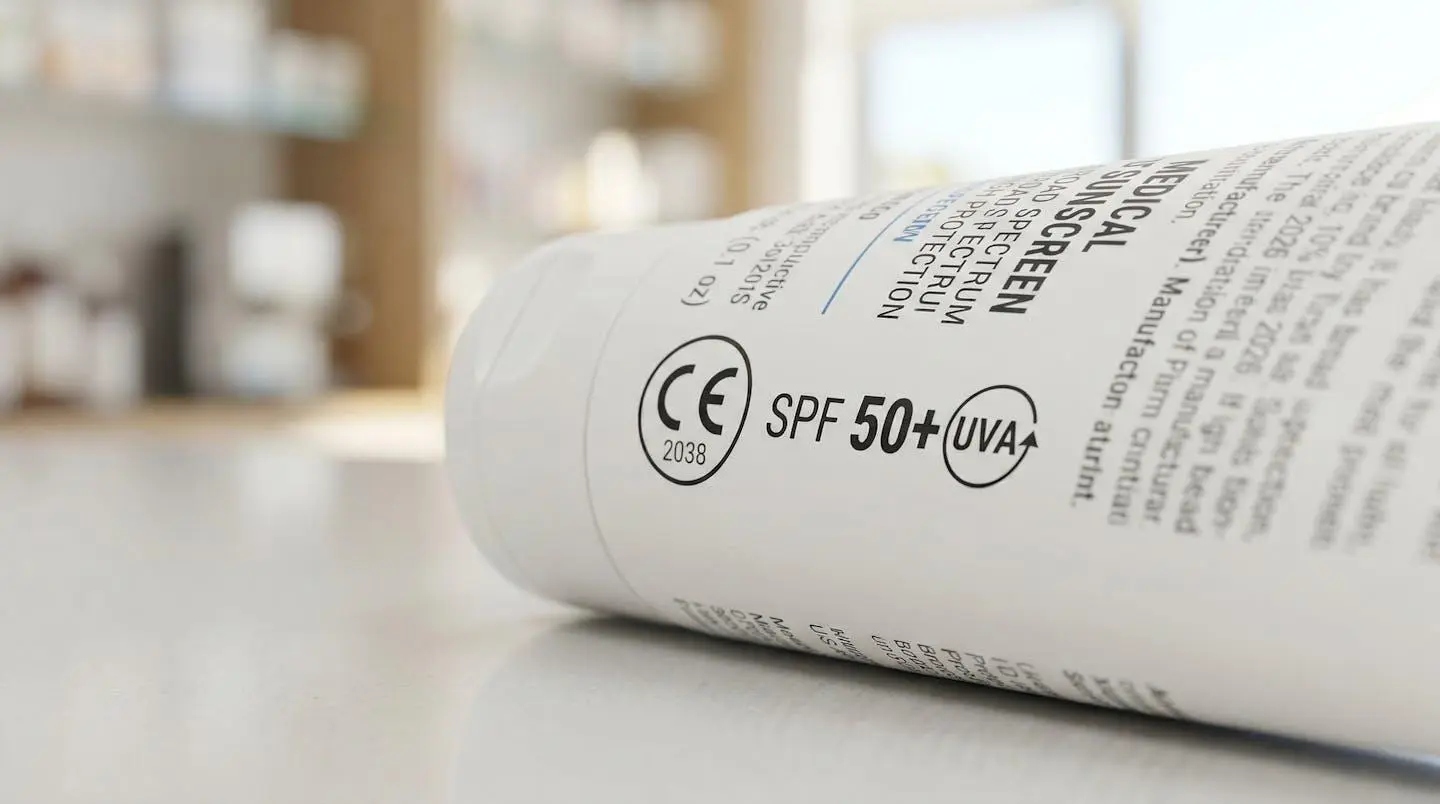
This evidence threshold matters because immunosuppressed patients are not simply « people with sensitive skin » requiring gentle formulations. They represent a distinct pharmacological and immunological population in whom standard photoprotection assumptions may not hold. A cosmetic sunscreen tested on healthy volunteers might demonstrate excellent SPF values in that context, yet never have been evaluated in transplant recipients whose altered skin biology and medication interactions could affect product performance. Products such as Actinica lotion 50+ exemplify this medical device category, having undergone clinical trials demonstrating efficacy in preventing actinic keratosis and squamous cell carcinoma in high-risk immunosuppressed patients.
The obligation to demonstrate therapeutic efficacy through clinical trials represents the cornerstone differentiating medical sunscreens from cosmetic alternatives. For CE medical device certification, manufacturers must conduct studies in representative patient populations—meaning immunosuppressed individuals if the intended use targets that group—and measure clinically relevant endpoints such as actinic keratosis incidence or squamous cell carcinoma development. The NIH clinical review documents precisely this type of evidence: broad-spectrum sunscreen with SPF greater than 60 significantly reduces the incidence of actinic keratosis, squamous cell carcinoma, and basal cell carcinoma over a 24-week period in organ transplant recipients. This statement describes not a theoretical benefit or marketing claim, but measured clinical outcomes in the target population.
Beyond regulatory status, medical-grade photoprotection often incorporates formulation characteristics optimised for compromised skin barrier function and enhanced photostability requirements. Immunosuppressed patients frequently present with xerosis, impaired wound healing, and increased susceptibility to irritant contact dermatitis. Medical sunscreens typically undergo dermatological testing in sensitive skin populations, employ non-comedogenic bases, and formulate without fragrances or potential sensitisers that might trigger reactions in immunologically altered skin. Photostability—the ability of UV filters to resist degradation under prolonged sun exposure—assumes heightened importance when patients require all-day protection with reapplication intervals extending up to two hours.
| Criteria | CE-Marked Medical Sunscreen | Cosmetic Sunscreen |
|---|---|---|
| Regulatory classification | Medical device (therapeutic indication) | Cosmetic product (general use) |
| Clinical trial requirement | Mandatory in target population (immunosuppressed) | Optional (typically healthy volunteers only) |
| Therapeutic claim allowed | Yes—prevents AK/SCC in high-risk patients | No—prevents sunburn only |
| Evidence in immunosuppressed populations | Required for CE medical device approval | Typically absent (not tested in this group) |
| Post-market surveillance | Mandatory MHRA medical device monitoring | Basic cosmetic safety requirements |
The clinical evidence behind actinic keratosis prevention
A persistent misconception circulates amongst both patients and some healthcare providers: that SPF 50 represents a universal standard of excellence, implying equivalent protection regardless of product source or regulatory status. This assumption collapses under scrutiny when examining clinical trial evidence in immunosuppressed populations. The critical question is not what SPF number appears on the label, but whether the product has demonstrated actual disease prevention—measured as reduced actinic keratosis incidence or squamous cell carcinoma development—in patients whose immune systems cannot mount normal responses to UV damage.
The evidence distinguishing effective from inadequate protection emerges from randomised controlled trials measuring hard clinical endpoints rather than surrogate markers. Broad-spectrum formulations with SPF exceeding 60 have demonstrated significant reductions in actinic keratosis, squamous cell carcinoma, and basal cell carcinoma incidence over 24-week periods in organ transplant recipients—the precise population at elevated risk. This is not theoretical protection inferred from laboratory UV transmission testing, but observed clinical benefit in the patients who need it most. Why does this evidence base remain confined to medical-grade products whilst cosmetic sunscreens, despite identical SPF numbers, lack comparable proof? Conducting multi-month randomised trials in transplant recipients requires specialist dermatology collaboration, ethical approval for vulnerable populations, and substantial investment. Cosmetic manufacturers face no requirement to undertake such studies when simpler SPF testing on healthy volunteers suffices for market access.
The disease continuum from actinic keratosis to invasive carcinoma assumes particular urgency in immunosuppressed patients. Research confirms that progression occurs more rapidly with lower likelihood of spontaneous regression in this population. Each actinic keratosis represents a precancerous lesion with genuine malignant potential in a patient whose impaired immune surveillance cannot reliably eliminate transformed cells.
For context, clinical research demonstrates that prophylactic acitretin, a systemic retinoid, substantially reduces squamous cell carcinoma and keratinocyte carcinoma incidence in transplant recipients—though with significant side effects including teratogenicity, hepatotoxicity, and mucocutaneous symptoms that limit tolerability. Photoprotection with medical-grade sunscreen offers a complementary or alternative strategy achieving meaningful risk reduction without systemic medication burden—provided the sunscreen has actually been proven effective in the target population rather than merely assumed equivalent based on SPF testing in healthy skin.
Practical photoprotection strategy for daily life
Consider the case of a 52-year-old liver transplant recipient on tacrolimus and mycophenolate who developed six actinic keratosis lesions on her forearms and face within two years post-transplant. Her dermatologist noted she had been using a cosmetic SPF 50 sunscreen purchased from a high-street pharmacy, applying it sporadically during summer months only. After switching to CE-marked medical SPF 60+ with daily year-round application and strict two-hour reapplication during outdoor activities, her follow-up examination six months later showed no new lesions and partial regression of two existing keratoses. This outcome illustrates the critical difference between sporadic cosmetic photoprotection and evidence-based medical-grade prevention.
Translating clinical evidence into daily practice requires addressing the practical realities of sunscreen selection, application technique, and integration with broader photoprotection measures. For immunosuppressed patients, sun protection is not an occasional summer consideration but a year-round medical necessity equivalent to medication adherence. The same diligence applied to taking immunosuppressive drugs on schedule must extend to photoprotection—any lapse creates opportunity for UV damage to accumulate in skin already compromised by impaired repair mechanisms.
Product selection begins with verification of CE medical device status and confirmation that clinical evidence exists for the intended use—preventing skin cancer or actinic keratosis in immunosuppressed populations. Patients should look beyond marketing claims to identify products explicitly approved for therapeutic indications rather than cosmetic photoprotection. The SPF threshold of 50+ represents the minimum acceptable level; formulations tested at SPF 60 or higher offer an additional margin of safety. Broad-spectrum coverage protecting against both UVA and UVB radiation is non-negotiable. Products should display the UVA logo or specify critical wavelength coverage extending into the UVA spectrum.
The single most common error undermining photoprotection effectiveness is inadequate application quantity. SPF testing uses 2 milligrams of product per square centimetre of skin—a thickness most users never achieve in practice. For the face and neck, this translates to approximately one-quarter teaspoon. Patients should apply sunscreen liberally rather than rubbing in a thin film until it disappears. Application should occur 15 to 30 minutes before sun exposure to allow the product to form an even film. Reapplication every two hours during continuous outdoor exposure represents the evidence-based standard, yet compliance remains poor even in high-risk populations.

Photoprotection alone, however rigorous, cannot reduce skin cancer risk to zero in immunosuppressed patients. Surveillance dermatology examinations at regular intervals—typically annually, though higher-risk patients may require six-monthly assessments—enable early detection of precancerous or malignant lesions before progression to invasive disease. Patients should familiarise themselves with their own skin geography, noting the location and appearance of existing moles, freckles, and any actinic keratosis lesions under treatment. Changes in size, colour, border irregularity, or symptom onset warrant prompt dermatological evaluation rather than waiting for the next scheduled appointment.
Self-examination monthly allows patients to identify new lesions or concerning changes in existing ones. Using a full-length mirror and handheld mirror to examine difficult-to-see areas, patients should adopt a systematic approach covering all body regions including frequently neglected sites such as ears, posterior neck, and lower legs. Photographing concerning lesions with a smartphone provides documentation useful for tracking changes over time and can be shared with dermatologists between appointments if uncertainty arises.
Your daily photoprotection protocol
- Apply CE-marked SPF 50+ medical sunscreen every morning, including overcast days and winter months
- Use adequate quantity: approximately one-quarter teaspoon for face and neck
- Apply 15 to 30 minutes before outdoor exposure to allow film formation
- Reapply every two hours during continuous sun exposure, and immediately after swimming or heavy perspiration
- Check expiry dates regularly—sunscreen filters degrade over time, reducing protection
- Combine sunscreen with protective clothing, wide-brimmed hats, and shade-seeking behaviour during peak UV hours
- Attend annual dermatology surveillance appointments (or more frequently if advised by your transplant team)
Adherence to this daily protocol requires the same discipline as medication compliance. Patients who integrate sunscreen into fixed routines—applying whilst brushing teeth each morning, keeping travel-size bottles in every bag, setting phone alarms for reapplication—achieve significantly higher consistency than those relying on memory or motivation. The behavioural anchor matters as much as the product choice.
One common error undermines even the most rigorous product selection: inadequate reapplication frequency. Patients often apply sunscreen once in the morning and assume protection persists throughout the day, yet this assumption creates dangerous vulnerability during afternoon UV peaks.
Critical reapplication reminder: Even water-resistant medical-grade sunscreen loses effectiveness over time. Protection degrades through UV exposure, physical removal via contact, and film thinning from perspiration. Reapplication every two hours during outdoor activities is non-negotiable for maintaining cancer prevention—a single morning application provides false security that leaves skin vulnerable during afternoon exposure when UV intensity often peaks.
Your questions about medical-grade sun protection
Immunosuppressed patients and their families frequently raise practical concerns about cost, availability, cosmetic acceptability, and prescription access for CE-marked medical sunscreen. Here are the answers to the most common questions.
Can I use regular high-street SPF 50 if I’m on immunosuppressive medication?
Regular cosmetic SPF 50 products provide sunburn protection but typically lack clinical evidence demonstrating actinic keratosis or skin cancer prevention in immunosuppressed populations. The critical difference is not the SPF number but the regulatory status and evidence base: CE-marked medical sunscreens have undergone trials in transplant recipients or similar high-risk groups, proving efficacy in the population that will use them. For patients whose cancer risk is elevated 65-fold or more, relying on products tested only in healthy volunteers represents inadequate risk management. Consult your transplant team or dermatologist about appropriate medical-grade photoprotection for your specific immunosuppression regimen.
Is medical-grade sunscreen available on NHS prescription?
NHS prescription availability for medical sunscreens varies by local Clinical Commissioning Group formularies and individual clinical circumstances. Some transplant centres or dermatology departments may prescribe photoprotection for patients at very high risk, whilst others consider it a non-prescription medical purchase. Your transplant team or GP can clarify local prescribing policies and whether your clinical situation warrants NHS provision. Even when not prescribed, medical sunscreens represent a cost-effective investment compared to the substantial healthcare costs and morbidity associated with treating multiple skin cancers or managing advanced squamous cell carcinoma requiring surgical excision or radiotherapy.
How much does CE-marked sunscreen cost compared to cosmetic brands?
Medical-grade sunscreens typically cost more than high-street cosmetic alternatives, reflecting the investment in clinical trials, regulatory approval processes, and specialised formulation for medical indications. Pricing varies by product and retailer, but expect to pay a premium compared to standard pharmacy sunscreens. However, context matters: the cost of a year’s supply of medical sunscreen is substantially lower than the expenses associated with treating even a single squamous cell carcinoma (surgical excision, histopathology, potential reconstructive procedures, time off work for treatment and recovery). For immunosuppressed patients facing dramatically elevated cancer risk, medical photoprotection represents preventive medicine with favourable cost-effectiveness compared to disease management.
Will medical sunscreen leave a white cast on my skin?
Modern medical sunscreen formulations have improved substantially in cosmetic elegance compared to older zinc oxide formulations that left pronounced white residue. Many CE-marked products now incorporate micronised mineral filters or elegant chemical filter combinations that minimise visible residue whilst maintaining high SPF and UVA protection. Some white cast immediately after application is common, particularly with higher SPF formulations, but typically diminishes as the product absorbs. Patients should prioritise proven cancer prevention efficacy over cosmetic elegance—a slight initial white appearance is a minor inconvenience compared to the consequences of inadequate photoprotection in high-risk populations.
Do I need to wear sunscreen indoors or on cloudy days?
Yes—UVA radiation penetrates window glass and cloud cover, meaning indoor exposure near windows and overcast outdoor conditions still deliver significant UV dose to skin. Whilst UVB (the primary sunburn wavelength) is largely blocked by glass and reduced substantially by clouds, UVA penetrates both and contributes meaningfully to photocarcinogenesis. For immunosuppressed patients, the recommendation is daily sunscreen application regardless of weather or indoor versus outdoor plans. This eliminates decision-making burden and ensures consistent protection. The British climate, characterised by frequent cloud cover, creates false security—UV exposure occurs even when sunshine is not visible or felt.
Can medical sunscreen completely prevent skin cancer in transplant patients?
No photoprotection strategy, however rigorous, reduces skin cancer risk to zero in immunosuppressed populations. Clinical trials demonstrate significant reduction in actinic keratosis and squamous cell carcinoma incidence with medical-grade sunscreen, but not complete elimination. Other factors—including duration and intensity of immunosuppression, genetic predisposition, cumulative lifetime UV exposure before transplantation, and individual variation in DNA repair capacity—all influence cancer risk independent of current photoprotection. Medical sunscreen is essential risk reduction, not risk elimination. It must be combined with other measures: protective clothing, shade-seeking, avoiding peak UV hours, and crucially, regular dermatology surveillance to detect and treat lesions early when cure rates are highest.
What should I do next to adopt evidence-based photoprotection?
The transition to evidence-based photoprotection begins with a conversation with your transplant team or dermatologist. Clarify which CE-marked products they recommend, whether NHS prescription is available in your area, and what dermatology surveillance schedule applies to your specific risk profile. Then integrate medical sunscreen into your daily routine with the same consistency as your immunosuppressive medication—both are medical necessities, not optional lifestyle choices. Your skin, already compromised by reduced immune defence, cannot afford inadequate protection during post-transplant life or long-term immunosuppression for autoimmune disease.
⚕ Important medical precautions
- This guide does not replace personalised medical advice from your transplant team or dermatologist
- Sunscreen effectiveness varies based on individual medical conditions and medication regimens
- CE marking requirements and medical device regulations may evolve—verify current standards with your healthcare provider
- Each immunosuppressed patient requires individualised photoprotection assessment and surveillance protocols
Explicit risks to understand:
- Risk of non-melanoma skin cancer increases substantially in solid organ transplant recipients (research indicates elevations of 65-fold or significantly higher)
- Risk of inadequate photoprotection if non-medical cosmetic sunscreen is used in place of CE-marked medical devices intended for high-risk patients
- Risk of actinic keratosis progression to invasive squamous cell carcinoma without proven medical-grade photoprotection and dermatological surveillance
For personalised guidance, consult your dermatologist, transplant physician, or specialist nurse.